
Picture a builder fitting out a shopfront. The job needs a hoarding on 20 square metres of footpath for 12 weeks. Before a single panel goes up, the local council wants a permit, and most councils charge by the area and the time the footpath is out of public use. Most will also want to see how pedestrians get past the work, and in OnPoint's experience that usually means two traffic plans, not one.
We reviewed the published 2026-27 fees and charges of all 31 Melbourne metropolitan councils to price that one job. Where the published fees let us price it cleanly, the council bill ran from $509 in Melton to $5,844 in Port Phillip, more than 11 times as much. Same footpath, same hoarding, same 12 weeks.
For anyone quoting construction, fit-out or shopfront work across Melbourne, that gap is real money, and it sits in the budget line most people guess.
At a glance
- $509 to $5,844: council fees for the same 12-week, 20 m2 footpath hoarding across 20 Melbourne councils (Webomaze analysis of 2026-27 schedules).
- About 3.5 times: the median inner-city council charges $4,572 for the job; the median outer-suburban council charges $1,275.
- At least 18 different labels for the approvals a builder needs to put a hoarding on a footpath across 31 councils, from "hoarding permit" to "building over public space".
- 11 of 31 councils published fees we could not turn into a price for the job without asking the council.
- Two plans, not one: in OnPoint's experience, almost every council asks for an installation plan for while the hoarding goes in, then an aftercare plan once it is in place.
- 10 councils list a separate fee to review or approve a traffic management plan or traffic guidance scheme, from $50 (Banyule) to $770 (Kingston, main roads).
One job, twenty different bills
The same footpath hoarding attracts council fees of $509 to $5,844 across the 20 Melbourne councils we could price, with a median of $3,195.[1] The figures include the council's application and permit fees, its charge for occupying the footpath, and any inspections the schedule makes compulsory. They leave out any separate Regulation 116 report and consent fee, which applies only where the building surveyor requires it, plus refundable bonds and asset protection permits, so the real bill may be higher.
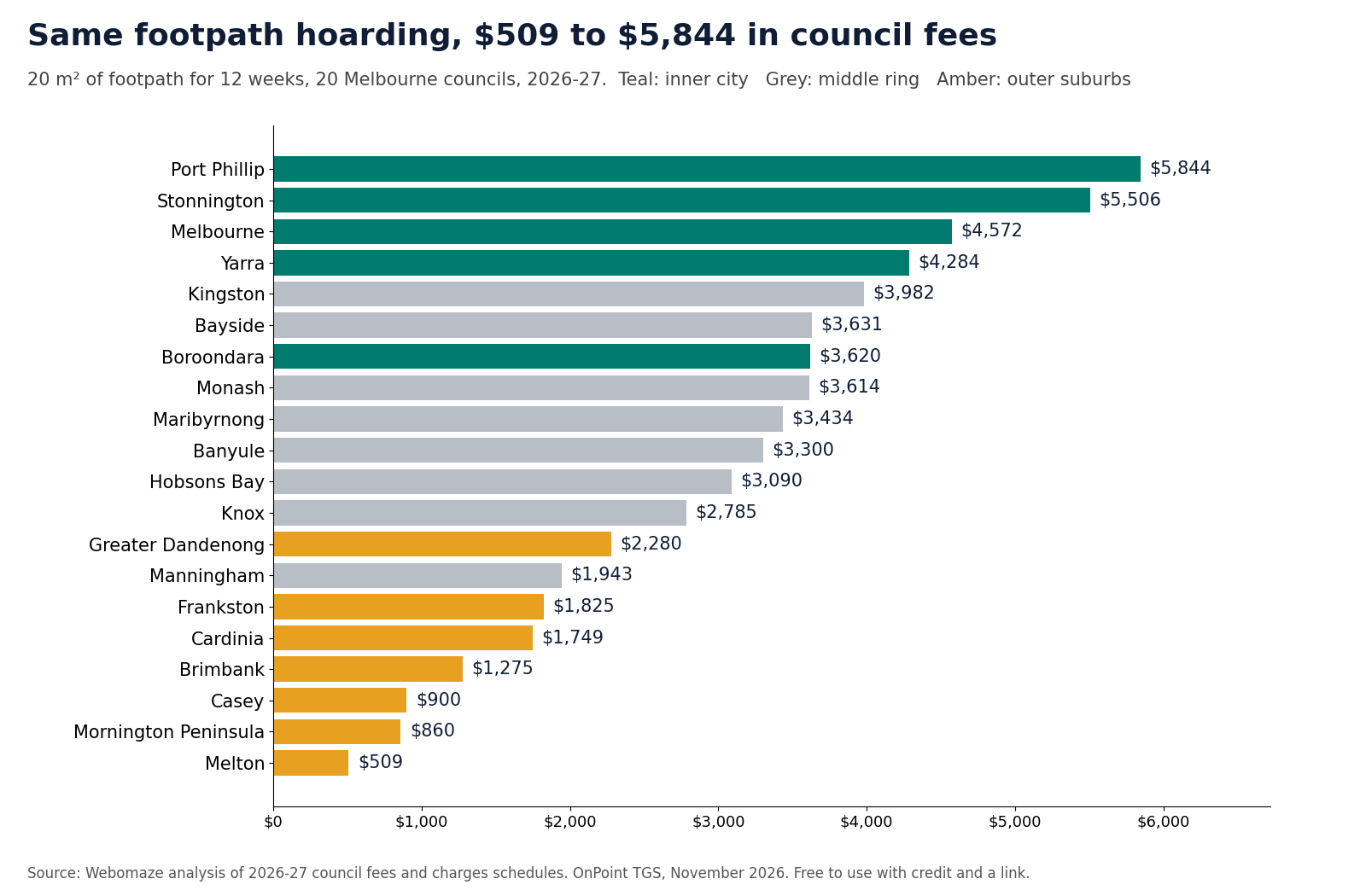
Council fees for 20 m2 of footpath hoarding for 12 weeks, 2026-27. Webomaze analysis of council fee schedules.
The biggest driver is the occupation charge. Stonnington charges $22 per square metre per week for a hoarding;[2] Brimbank charges $4.50.[3] Over 12 weeks and 20 square metres, that alone is $5,280 against $1,080.
A builder pays $5,506 in Stonnington and $900 in Casey for the same 12 weeks of footpath.
One hoarding, two plans
The permit fee is only part of the paperwork. Most councils also want to see how people will get past the work, and the plan they need changes once the hoarding is up.
"Almost every council will request a second plan when it comes to hoarding. The first is an installation plan, which is normally a full footpath closure showing the measurements while the hoarding goes in. The second is the aftercare plan. Once the hoarding is in place, council wants a plan showing where the hoarding sits, the measurements across the footpath, and whether pedestrians remain on the footpath or are being diverted."
The two plans below come from one of OnPoint's own hoarding jobs. The first covers the short, busy stage while the panels go in. The second shows the hoarding in place for the rest of the job: where it sits, how much footpath is left, and where pedestrians walk. On this job, traffic controllers managed pedestrians on the footpath while the panels went in; how installation is handled varies from site to site.
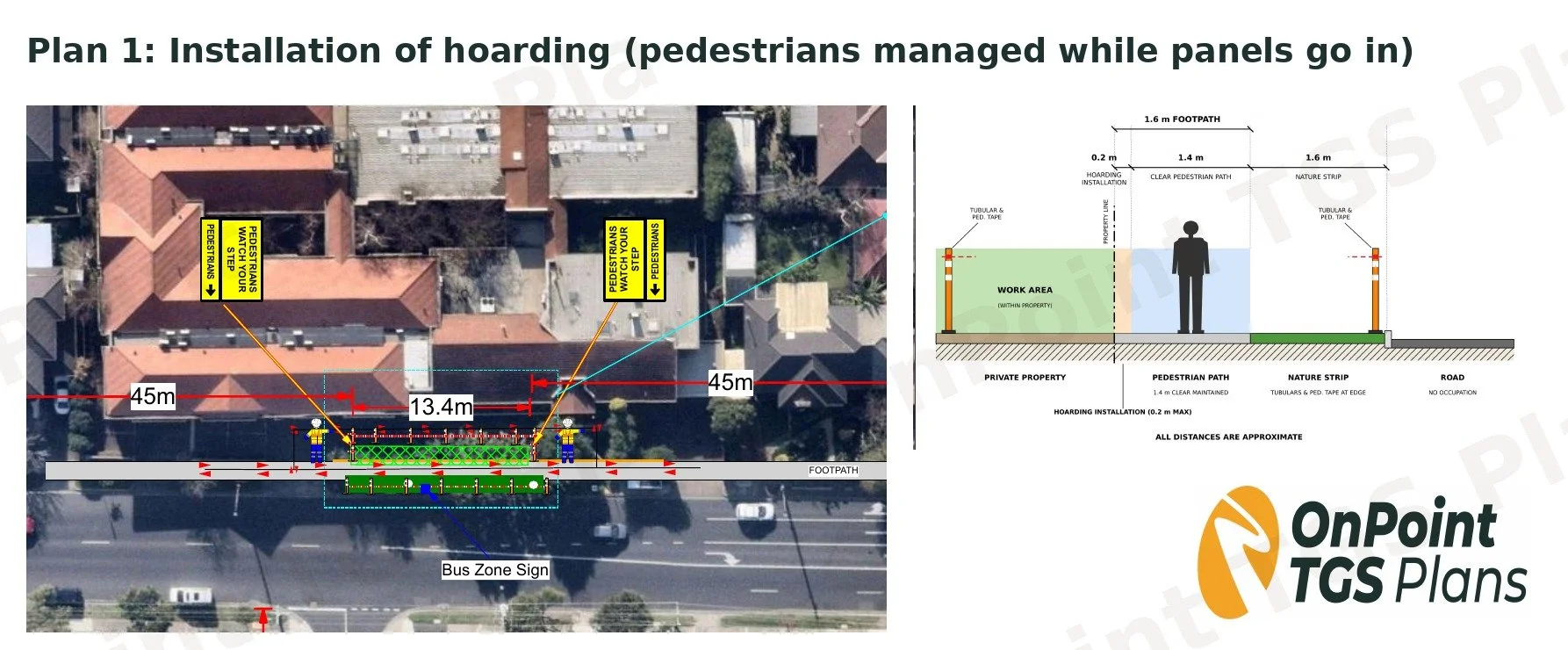
Plan 1, installation: pedestrians are managed on the footpath while the hoarding panels go in. From an OnPoint TGS job, with the address and client details removed.
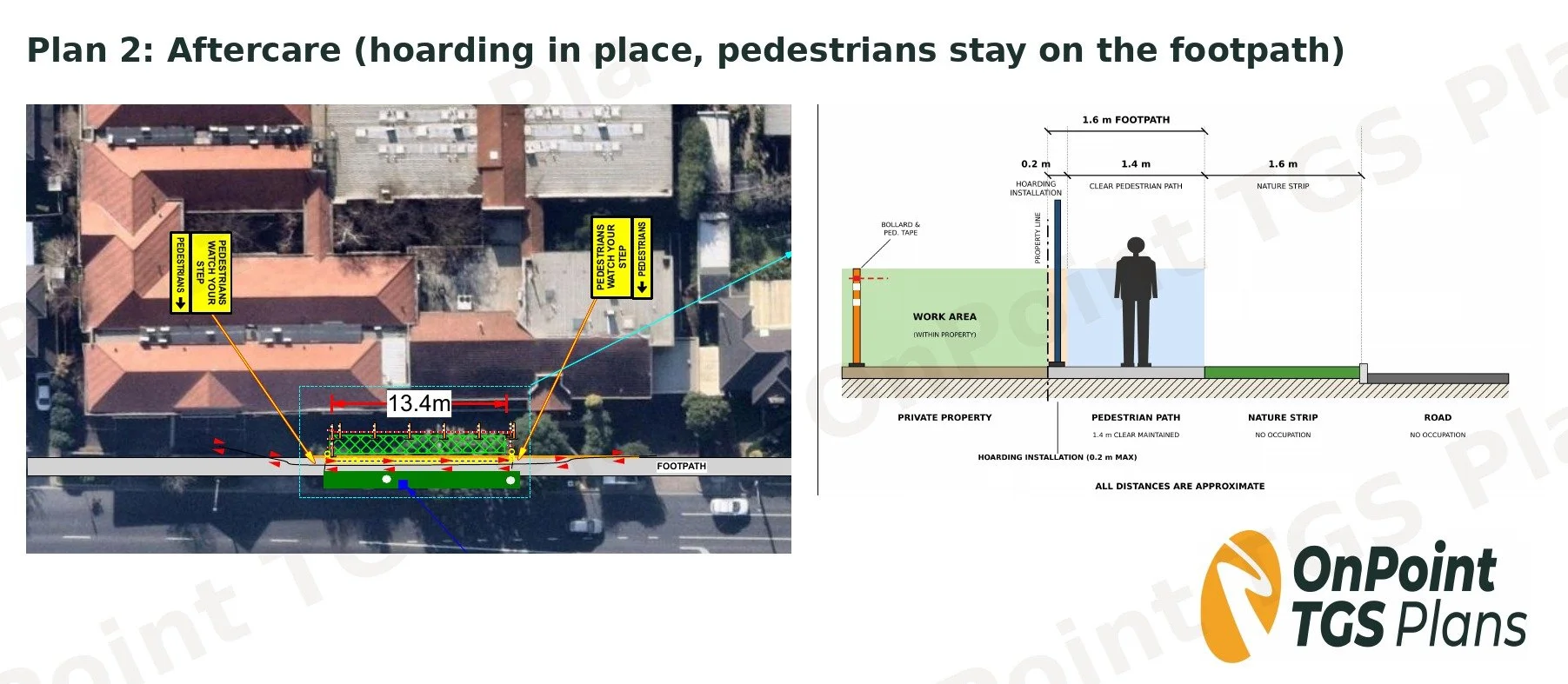
Plan 2, aftercare: the hoarding is in place and pedestrians stay on the footpath. From the same OnPoint TGS job, with the address and client details removed.
Published council requirements ask for the same kind of detail. The City of Ballarat's hoarding and occupation fact sheet, for example, asks for a plan showing the footpath width measured from the kerb, the area to be occupied and a minimum clear pedestrian width of 1.5 metres, and requires a traffic management plan and pedestrian management plan where pedestrians are diverted onto or across a road.[26] OnPoint's advice to builders is to have both plans drawn before lodging, rather than finding out about the second one when council asks for it.
Inner-city councils charge about three and a half times as much
The median inner-city council charges $4,572 for the job, the middle ring $3,367 and the outer suburbs $1,275.[1] Land is worth more in the inner city and footpaths are busier, so some gap is expected. A gap of three and a half times is a different matter for a small builder or a shop owner budgeting a fit-out.
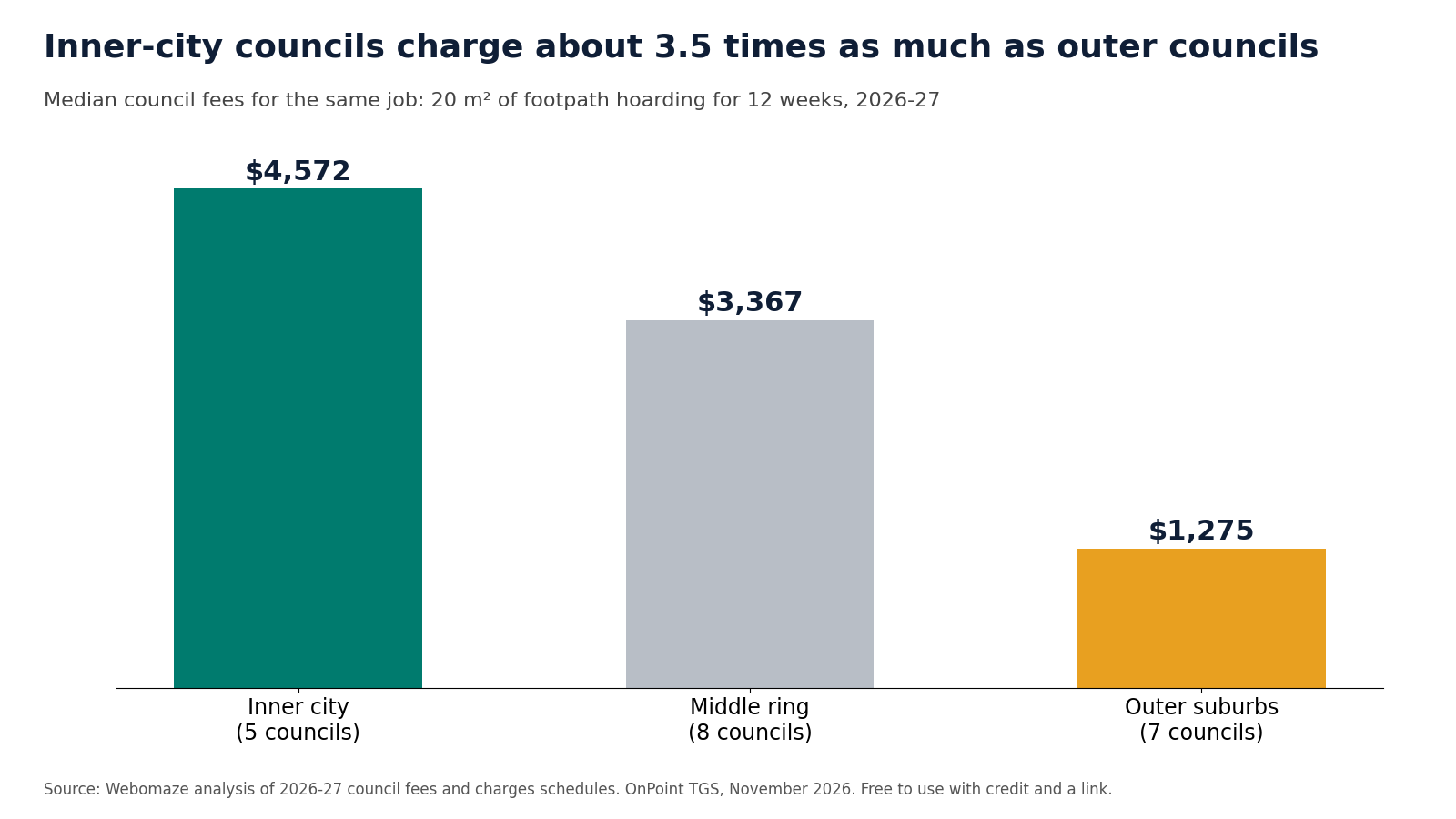
Median council fees by ring, 2026-27. Webomaze analysis.
| Inner city | Middle ring | Outer suburbs | |
|---|---|---|---|
| Councils priced | 5 | 8 | 7 |
| Median council fees | $4,572 | $3,367 | $1,275 |
| Range | $3,620 to $5,844 | $1,943 to $3,982 | $509 to $2,280 |
| How most charge | Per m2 per week or per day, plus application | Per m2 per week, plus application | Flat fees or monthly minimums |
Inner city: Melbourne, Yarra, Port Phillip, Stonnington, Boroondara. Outer suburbs: Brimbank, Cardinia, Casey, Frankston, Greater Dandenong, Melton, Mornington Peninsula. These groupings are ours. The other eight are middle ring.
Eighteen labels for one hoarding
Across Melbourne's 31 councils we recorded at least 18 different labels for the approval a builder applies for to put a hoarding on a footpath.[1] They are not always the same legal permit: some are local law occupation permits, one is a Road Management Act consent and some are tied to the building regulations. The City of Melbourne calls it a temporary protective structure permit, Knox calls it building over public space, Monash an occupy roadway permit, Hume treats it as a consent to work within a road reserve, and Darebin a precautions permit. Eight councils simply call it a hoarding permit.
The Victorian Government has noticed. The Department of Treasury and Finance's November 2025 guide for councils says "Victorian councils currently vary in the names used for public protection permits" and encourages a common naming convention to reduce confusion for builders who work across several councils.[4] The same guide says clear triggers and an online form can typically cut turnaround times by two days.[4]
At 11 councils, the published fees can't be priced
For 11 of the 31 councils, the published schedule did not let us work out what the job would cost without phoning the council.[1] The reasons are mundane but telling: a rate with no time period, two fee regimes from two council teams for the same hoarding, a printed rate that conflicts with the council's own web page, or a 2026-27 rate we could not confirm.
| Council | What the published fees show |
|---|---|
| Glen Eira | Two overlapping regimes: a hoarding permit at $260 a week plus $10 per m2, and a footpath occupancy at $236.50 a day plus $6 per m2 a day[5] |
| Merri-bek | $5.90 per m2 "all day", with no period stated[6] |
| Darebin | Daily footpath rates of $81.29 to $284.73 and a new $10 per m2 per month land fee; which applies to a hoarding isn't stated[7] |
| Whitehorse | Two regimes: $2.30 per m2 per day (minimum $425 a week) and $5 per m2 per week plus inspections[8] |
| Maroondah | Schedule says $7.20 per m2 per day; the council's web page says per week[9] |
| Hume | Hoardings are lodged as a road reserve works consent ($405.80 or $744.30 depending on road speed), valid for 60 days; the form doesn't say what a longer job costs[24] |
| Wyndham | $5.20 per m2 per week, but no clearly labelled application fee[11] |
| Yarra Ranges | Only the statutory consent fee is listed; no occupation charge[12] |
| Nillumbik | The 2026-27 schedule ($6 per m2 per week, or a $100 a day minimum) and the permit page ($5 per m2 per week) don't agree |
| Moonee Valley, Whittlesea | We could not confirm a usable adopted 2026-27 hoarding rate from the material available on 11 November 2026 |
None of this suggests anyone is doing the wrong thing. It does mean a builder pricing work in three council areas can't compare like with like from the published documents alone.
Ten councils add a separate review fee
Ten Melbourne councils publish a separate charge to review, check or approve a traffic management plan or traffic guidance scheme, from $50 at Banyule to $420 for a local road and $770 for a main road at Kingston.[13][14] The labels and methods differ: Maribyrnong charges $93 an hour, and Greater Dandenong and the Mornington Peninsula charge by road speed. Maroondah instead charges a temporary traffic management permit fee from $303 for one to three days to $1,515 for 31 days or more.[9]
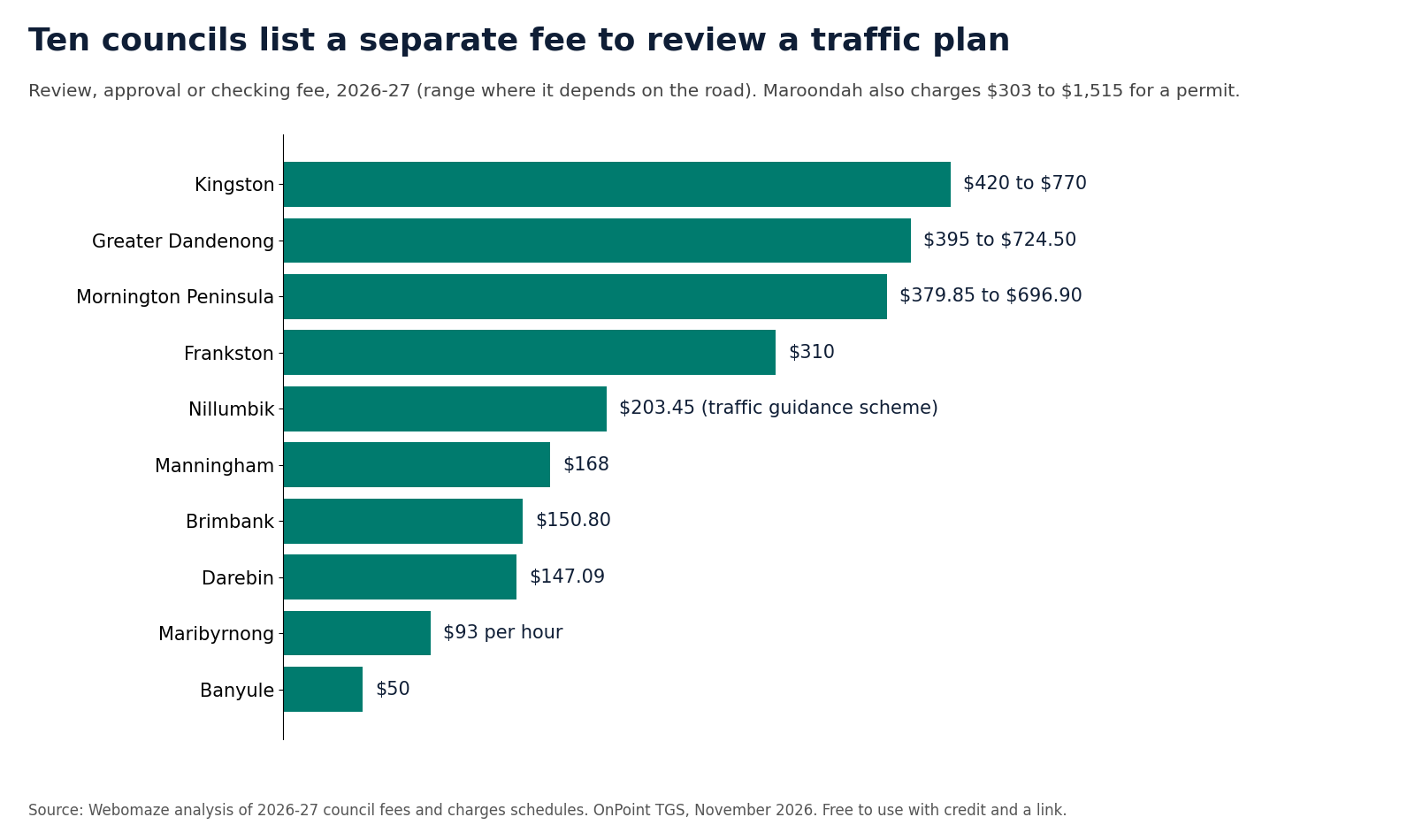
Council fees to review a traffic plan, 2026-27. Webomaze analysis.
Whether you need a plan at all also depends on the council. Our review classed 15 of the 31 councils as routinely asking for a traffic or pedestrian management plan with the footpath or hoarding application, ten as asking when the work affects the road or footpath, and six whose published material doesn't state a clear rule.[1] Kingston, for example, charges its $2.37 per square metre per day occupation fee on top of the assessment.[14] If a job is going to need one, it pays to know before the permit clock starts. Our guide on whether a shopfront, sign or footpath job needs a traffic plan at all covers the common triggers.
Regional Victoria and interstate
In the three regional Victorian examples, the same job costs less than the Melbourne median. Interstate charges vary widely. Ballarat charges a flat $200 hoarding permit,[15] Bendigo $1,032 outside the CBD (three months at $344)[16] and Geelong $1,930 for a commercial street ($250 lodgement plus $1 per m2 per day).[17]
| Council | How it charges | 20 m2 for 12 weeks |
|---|---|---|
| City of Melbourne (for comparison) | $2.60 per m2 per day plus $203.70 application[18] | $4,572 |
| City of Adelaide | $0.50 per m2 per day for hoarding, $32 minimum per application[19] | $840 |
| City of Charles Sturt (SA) | $57 application, $4 per m2 per week, 20% off after 8 weeks[20] | $825 |
| City of Launceston | $4.20 per m2 per week outside the CBD, $5.20 inside[21] | $1,008 (outside CBD) |
| City of Hobart | $5.30 per m2 per week outside the CBD for the hoarding, plus a long-term construction occupation rate of $6.50 per m2 per week for permits over a week[22] | $2,832 (outside CBD) |
| City of Darwin | $110 works permit, then $80 a day where traffic isn't interrupted[23] | $6,830 |
The City of Melbourne's daily rate per square metre is more than five times the City of Adelaide's hoarding rate. Darwin is the outlier the other way: it charges by the day rather than by the square metre, so a small, long job costs more there than at any Melbourne council we priced.
What to do before you quote
- Price the permit from the council's own 2026-27 schedule, not last year's job. Wyndham's hoarding rate rose 23.8% this year; Geelong's lodgement fee fell from $309 to $250.[11][17]
- Measure the area and the weeks honestly. Most councils charge per square metre per week or per day, so a hoarding that stays up two extra weeks costs two extra weeks.
- Budget the report and consent fee separately. Where the building surveyor requires it, the fee varies by council and is not in our figures.
- Allow for two plans, not one. An installation plan for while the hoarding goes in and an aftercare plan for once it is up. Drawing both before lodging saves waiting to be asked for the second.
- Ask early whether the council needs a traffic management plan and whether it charges to assess it. Published processing guidance runs from five to 20 business days, assuming a complete application.[1]
- If the job closes a footpath or touches the road, sort out the traffic and pedestrian plan for the construction site at the same time as the permit, so one doesn't hold up the other.
Frequently asked questions
What is a hoarding permit in Victoria?
It is a council permit to put a hoarding, gantry, scaffold or other public protection structure on a public footpath or road during building work. Councils use different names for it, including street occupation permit, road occupation permit and public protection permit. It is separate from the report and consent a building surveyor may require under regulation 116 of the Building Regulations 2018.[4]
How much are hoarding permit fees in Melbourne?
For 20 m2 of footpath for 12 weeks, council fees ranged from $509 to $5,844 across 20 Melbourne councils in 2026-27, with a median of $3,195. Inner-city councils charge the most. Add the report and consent fee and any bond.
Why do fees differ so much between councils?
Each council sets its own local law fees. Some charge per square metre per week, some per day, some a flat monthly fee, and some a single application fee with no occupation charge.
How long does a hoarding permit take?
Councils that state a time mostly ask for 5 to 15 business days; Hume allows up to 20 business days after payment, and Casey usually processes within 14 business days.[1]
Do I need a traffic management plan for a hoarding?
We classed 15 of Melbourne's 31 councils as routinely asking for a traffic or pedestrian management plan with the application, and another ten as asking when the work affects the road or footpath. In OnPoint's experience, almost every council asks for two plans for a hoarding: an installation plan for while it goes in, and an aftercare plan showing where it sits and how pedestrians get past once it is up. Check the council's permit page before you lodge. If you need one, having the plan drawn and ready to lodge with the application avoids a second round.
How we did the numbers
Inputs: the published 2026-27 fees and charges schedules of Melbourne's 31 metropolitan councils, plus Geelong, Ballarat, Bendigo, Hobart, Launceston, Adelaide, Charles Sturt and Darwin, read between 10 and 11 November 2026, with council permit web pages where the schedule was silent.
Scenario: a commercial job with a hoarding on 20 m2 of footpath for 12 weeks (84 days), at the council's standard rate (not an activity-centre or CBD premium, except in the City of Melbourne, which has one rate). The model assumes no parking-bay loss, no arterial-road charge, no gantry and no lane closure. Where an adopted 2026-27 rate could not be confirmed, we did not calculate a price.
Included: council application and permit fees for the hoarding or occupation permit, the occupation charge, and inspections the schedule makes compulsory. Excluded: the statutory report and consent fee, bonds and deposits, asset protection permits, optional fast-track fees and traffic management plan assessment fees.
Assumptions: monthly fees are charged for three months; Knox's $200 weekly cap for two to four months applies; Casey's $900 minimum applies; Mornington Peninsula's $430 hoarding permit and its $430 footpath occupation permit for more than 7 days both apply; inspection fees are counted only where the schedule makes them part of the application (Yarra, Maribyrnong). Greater Dandenong's rate is as printed ($38 per m2 per month, up from $8 the year before) and is worth confirming with the council.[10] Port Phillip's figures use the council's street occupation permit page, which ABLIS lists as current for 2026-27, because the fee schedule was not available to verify.[25] Groupings (inner, middle, outer suburbs) are ours.
Limits: councils can vary fees case by case, and a real job may attract other charges. This is a like-for-like comparison of published fees, not a quote. Every input, source and page is in the downloadable data.
Use this data
Free to use with credit to OnPoint TGS and a link to this page. Download the full council-by-council data (CSV). Media enquiries: operations@onpointtgs.com.au.
OnPoint TGS Plans is an independent traffic management planning consultancy working across Victoria, South Australia, Tasmania and the Northern Territory. It is accredited by the Department of Transport and Planning for temporary traffic management design (Categories 1 and 2).
Sources
- Webomaze analysis of 2026-27 council fees and charges schedules and permit pages for 31 Melbourne councils (council list and every input in the downloadable data), November 2026.
- City of Stonnington, Final Adopted Budget 2026-27, Appendix B fees and charges. hdp-au-prod-app-ston-connect-files.s3.ap-southeast-2.amazonaws.com/2617/8573/6441/Final_Adopted_Budget_2026-27_June_26.pdf
- Brimbank City Council, Budget 2026-27, Appendix 5 fees and charges. serviceapi.brimbank.vic.gov.au/CMServiceAPI/Record/8143180/file/document
- Victorian Government, Guide to Public Protection Permits, November 2025. vic.gov.au/sites/default/files/2025-11/Guide-to-Public-Protection-Permits.docx
- Glen Eira City Council, 2026-27 user fees. gleneira.vic.gov.au/media/1hupvphx/2026-27-user-fees-master.pdf
- Merri-bek City Council, Budget 2026-30 (adopted), fees and charges. merri-bek.vic.gov.au (adopted budget PDF)
- Darebin City Council, Fees and charges schedule 2026-27. darebin.vic.gov.au (fees and charges 2026-27 PDF)
- Whitehorse City Council, 2026-27 Adopted Budget, fees and charges. whitehorse.vic.gov.au (adopted budget PDF)
- Maroondah City Council, Fees and charges 2026-2027. maroondah.vic.gov.au (fees and charges 2026-27 PDF)
- Greater Dandenong City Council, Budget 2026-27, section 6 fees and charges. greaterdandenong.vic.gov.au (budget PDF)
- Wyndham City Council, 2026-2027 Adopted Fees and Charges. wyndham.vic.gov.au (adopted fees and charges PDF)
- Yarra Ranges Council, Fees and charges 2026-2027. yarraranges.vic.gov.au (fees and charges PDF)
- Banyule City Council, Adopted fees and charges schedule 2026/27. banyule.vic.gov.au (fees and charges PDF)
- City of Kingston, Road occupation and works permit page, and Adopted Budget 2026/27. kingston.vic.gov.au (road occupation and works permit)
- City of Ballarat, Budget 2026-27, schedule of fees and charges. ballarat.vic.gov.au (budget PDF)
- City of Greater Bendigo, Budget 2026-2027 (published 21 August 2026). bendigo.vic.gov.au (budget PDF)
- City of Greater Geelong, 2026-2027 Budget, Appendix 4 fees and charges. geelongcity.vic.gov.au (budget PDF)
- City of Melbourne, Budget 2026-27, fees and charges (pages 146 to 147). melbourne.vic.gov.au (budget fees PDF)
- City of Adelaide, Schedule of fees and charges 2026-27. cityofadelaide.com.au/about-council/schedule-of-fees-and-charges
- City of Charles Sturt, Fees and Charges Register 2026-27. charlessturt.sa.gov.au (fees register PDF)
- City of Launceston, Fees and charges 2026-2027 (v7). launceston.tas.gov.au (fees and charges PDF)
- City of Hobart, Fees and charges 2026-27 (updated 12 October 2026). hobartcity.com.au (fees and charges PDF)
- City of Darwin, Municipal Plan 2026-27 fees and charges. darwin.nt.gov.au (fees and charges PDF)
- Hume City Council, Consent to work within a Hume City Council road reserve (form, July 2026). hume.vic.gov.au (consent form PDF)
- City of Port Phillip, Street occupation permit. portphillip.vic.gov.au/planning-and-building/construction-permits/street-occupation-permit/
- City of Ballarat, Hoarding and Occupation Fact Sheet. ballarat.vic.gov.au (hoarding and occupation fact sheet PDF)
