
Services: Construction traffic management plans
Construction Traffic Management Plans (CTMP)
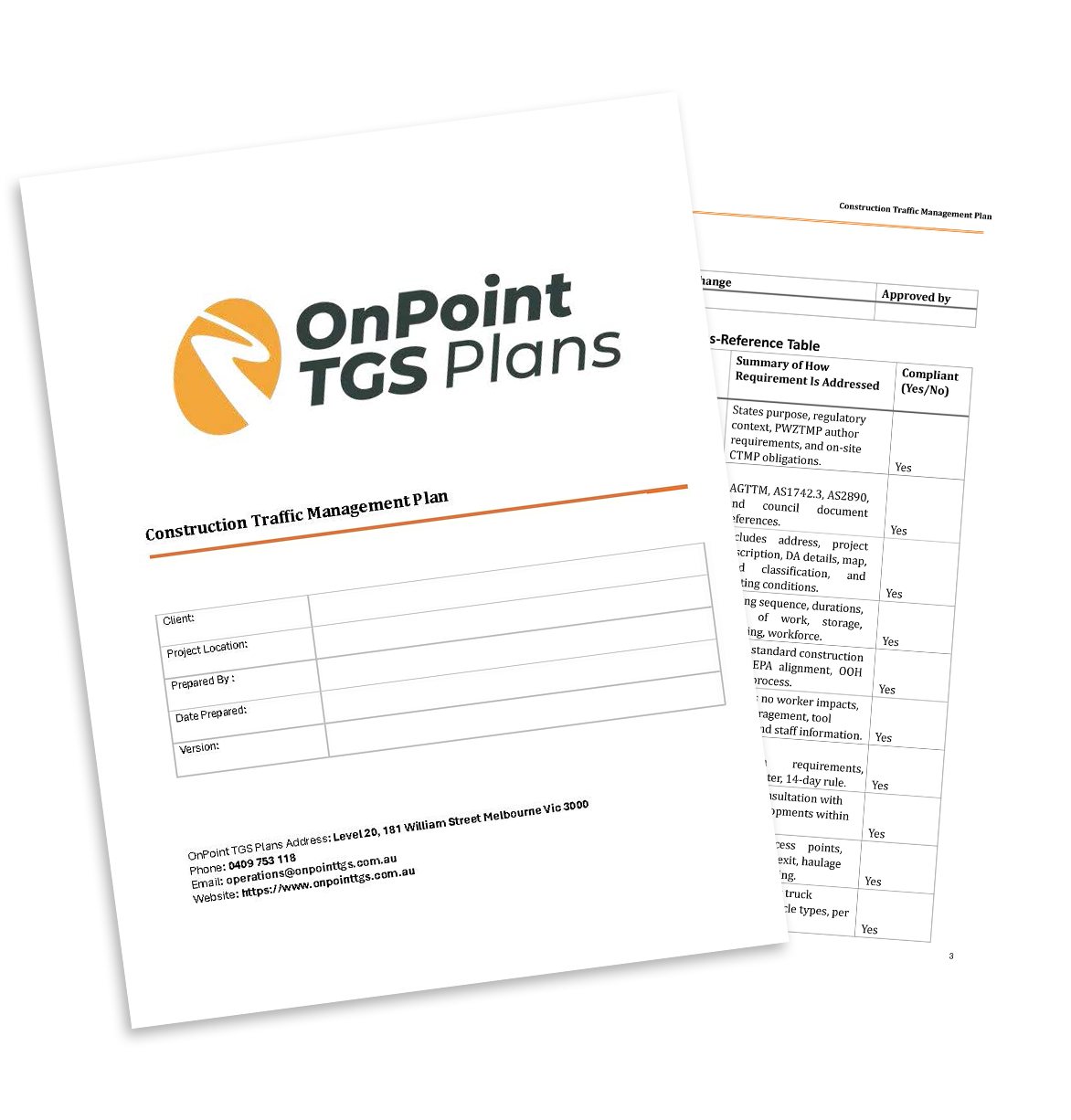
A Construction Traffic Management Plan (CTMP) is a council-ready document that sets out how vehicles, pedestrians, cyclists and site traffic will be safely managed throughout a construction project. It is one of the most commonly requested traffic documents in Australia. Councils, VicRoads, project managers and superintendents typically require a CTMP as a condition of planning permit approvals, construction management plan submissions, and works permits where the build impacts public roads, footpaths or parking.
OnPoint TGS prepares council-ready CTMPs for builders, developers and civil contractors across Victoria, Tasmania, South Australia and the Northern Territory. We deliver CTMPs as standalone documents or as part of a complete traffic management package. Same-day turnaround is standard.


Why builders and developers choose us


Fast turnaround, typically 1 to 2 business days when information is provided
100% council approval track record


Work directly with the planner preparing your CTMP
Site visits available where required

Experienced with residential builds and developments
When does a council require a CTMP?
A CTMP becomes a permit condition when your construction project will affect how people use the public realm around the site. The common triggers we see across Victoria and the other states we work in:
Your planning permit lists a CTMP as a condition of approval
The works require a road occupancy permit or works-within-road-reserve permit
A construction management plan (CMP) is required and the council asks for a traffic component
The site is on or near an arterial road managed by VicRoads or another road authority
The project involves heavy vehicle movements that affect surrounding streets
Construction parking, deliveries or material storage will encroach on the road, footpath or nature strip
For projects in busy urban areas — typical for inner Melbourne, Hobart CBD or Adelaide CBD — a CTMP is almost always part of the permit package. For smaller residential or rural projects, it may not be required. We can give you a clear answer based on your site address and works description, usually within a few minutes.
What a CTMP must contain
A compliant CTMP for an Australian council or road authority needs to address:
Project description — site location, scope of works, expected start and completion dates, hours of operation, contractor details
Traffic generation — truck movements per day, vehicle types, peak movement times, delivery scheduling
Site access arrangements — where vehicles enter and exit, swept paths for the largest vehicle type, any temporary changes to street parking or footpaths
Pedestrian and cyclist management — how the footpath stays open or is detoured, pedestrian signage, separation from vehicle paths
Risk assessment — the hazards the project creates and the controls to manage them
Approvals and permits — which road authority and council permits are required, and how the CTMP supports those applications
For larger or higher-risk projects, the CTMP will also include a Traffic Guidance Scheme (TGS) — the scaled diagram that shows where signs, cones, barriers and traffic controllers are placed. We prepare both together as part of a single integrated package.
CTMP and TMP — what's the difference?
A Construction Traffic Management Plan (CTMP) is a specific type of Traffic Management Plan (TMP)focused on the construction phase of a project. A TMP is the broader category — it covers any temporary works that affect traffic, including events, maintenance, utility works and construction.
For most permit applications you will be asked specifically for a CTMP rather than a generic TMP, because the council is asking about how the build will be managed. The terms are sometimes used interchangeably by councils and contractors, but they are not the same document. If you are unsure which one you have been asked for, the wording on the permit condition usually tells you — and we can confirm before drafting.
How long does a CTMP take to prepare?
Standard turnaround for a single-site CTMP at OnPoint TGS is four business hours from confirmed payment, provided we have the site details. Same-day delivery is the norm for jobs received before midday.
Multi-stage projects, complex CBD sites, or projects requiring multiple TGS layouts will take longer — typically one to two business days. We tell you upfront if the scope means it cannot be completed same-day, so you can plan around it.
State-specific requirements
Victoria. Works on arterial roads managed by the Department of Transport and Planning require a CTMP prepared to AGTTM Part 3 standards. Local road works are approved by the relevant council. Inner-Melbourne councils (City of Melbourne, Yarra, Stonnington, Port Phillip) have stricter pedestrian management requirements than outer metro councils. We prepare CTMPs to each council's preferred documentation format.
Tasmania. The Department of State Growth and Hobart City Council both require CTMPs for construction works affecting state and council roads. Smaller Tasmanian councils generally follow state requirements with light variations. OnPoint TGS has extensive experience preparing CTMPs for projects across Tasmania.
South Australia. The Department for Infrastructure and Transport administers CTMP submission through the Road Works and Events Coordination (RWEC) unit. Standard processing takes up to 10 business days, so getting the document right first time is critical for project timelines.
Northern Territory. The Department of Infrastructure, Planning and Logistics (DIPL) administers CTMP approvals. Remote and high-speed road conditions often require additional buffer distances and risk controls within the document.
Get A CTMP Quote
Submit your site details online and we will return a fixed quote within two business hours. You'll need the site address, a short works description, expected start and completion dates, and the road type. Most clients receive a draft CTMP the same day.
Frequently Asked Questions
-
Often yes — even for single-dwelling builds in established suburbs, the council will frequently require a CTMP if construction vehicles will use the road or footpath, if a crane or concrete pump is needed, or if waste skips will be parked on the street. Check your planning permit conditions. If a CTMP is listed, you need one before works can start.
-
You can if you hold the relevant traffic management qualifications (RIIWHS302E or the AGTTM-aligned equivalent). For commercial projects, councils generally expect the document to be prepared by a qualified traffic management planner. A non-compliant or poorly drafted CTMP is one of the most common reasons construction permits are delayed, so using a specialist is usually faster and cheaper in practice.
-
The CTMP is normally attached to the planning permit, building permit, works permit or road occupancy application. Some councils have an online portal; others accept email or hard copy. We provide the CTMP in PDF format ready for submission, and can assist with the application if you'd like us to manage it on your behalf.
-
Yes — the demolition phase is treated as a construction phase for CTMP purposes. If the demolition involves road or footpath impacts (which it usually does, given truck movements and skip placement), the CTMP needs to address it. We commonly prepare CTMPs that cover demolition and the subsequent build as a single document with staged layouts.
-
Item deA Construction Management Plan (CMP) is a broader document about the overall management of the build — including waste, noise, hours of operation, environmental management and traffic. The CTMP is the traffic component, often required as an attachment to the CMP. For permit purposes, councils typically want both, and the CTMP supplies the traffic section that the CMP cannot.