
What is a Traffic Management Plan (TMP)?
A Traffic Management Plan (TMP) is a formal document that describes how traffic, pedestrians and other road users will be safely managed around a worksite or event on a public road. It is required by road authorities and councils across Australia for most roadworks and construction activities that affect traffic flow.


Understanding Traffic Management Plans
A Traffic Management Plan is a site-specific document that details the overall strategy for managing traffic safely during a period of works. It covers the scope of work, the risk environment, the temporary traffic control measures to be applied, and how affected parties will be notified and managed.
Unlike a Traffic Guidance Scheme (TGS), which is a physical layout diagram showing device placement, a TMP is the management document that wraps around it. For most commercial and infrastructure projects, both documents are required.
When is a TMP Legally Required?
A TMP is required in Australia for any work activity that:
Takes place on or immediately adjacent to a public road, including road reserves
Involves a lane closure, road closure or change to the normal flow of traffic
Requires temporary signals, speed limit changes or traffic controllers
Is classified as medium-risk or high-risk under the relevant state's code of practice
In Victoria, Tasmania, South Australia and the Northern Territory, council and road authority permit applications for road works must be accompanied by a TMP before approval will be granted. WorkSafe obligations also require a TMP for activities where traffic hazards create risks to workers.
A Traffic Management Plan and a Traffic Guidance Scheme are related but distinct documents.
A TMP is the full management document. It describes the project, identifies the risks, sets out the traffic control strategy, and covers emergency response, stakeholder communication and work scheduling.
A TGS is the physical layout component. It is a scaled diagram showing where every sign, cone, barrier and device is placed on and around the site.
In practice: a TGS is often prepared as an attachment to a TMP. For small, low-risk jobs, a TGS alone may be accepted. For anything involving lane closures on arterial roads, council permits or construction projects, a full TMP including a TGS will be required.
TMP vs TGS — The Key Differences
What a TMP Document Must Contain
A compliant Traffic Management Plan prepared to AGTTM standards must include:
Project details: site address, job description, dates, hours of work and contractor information
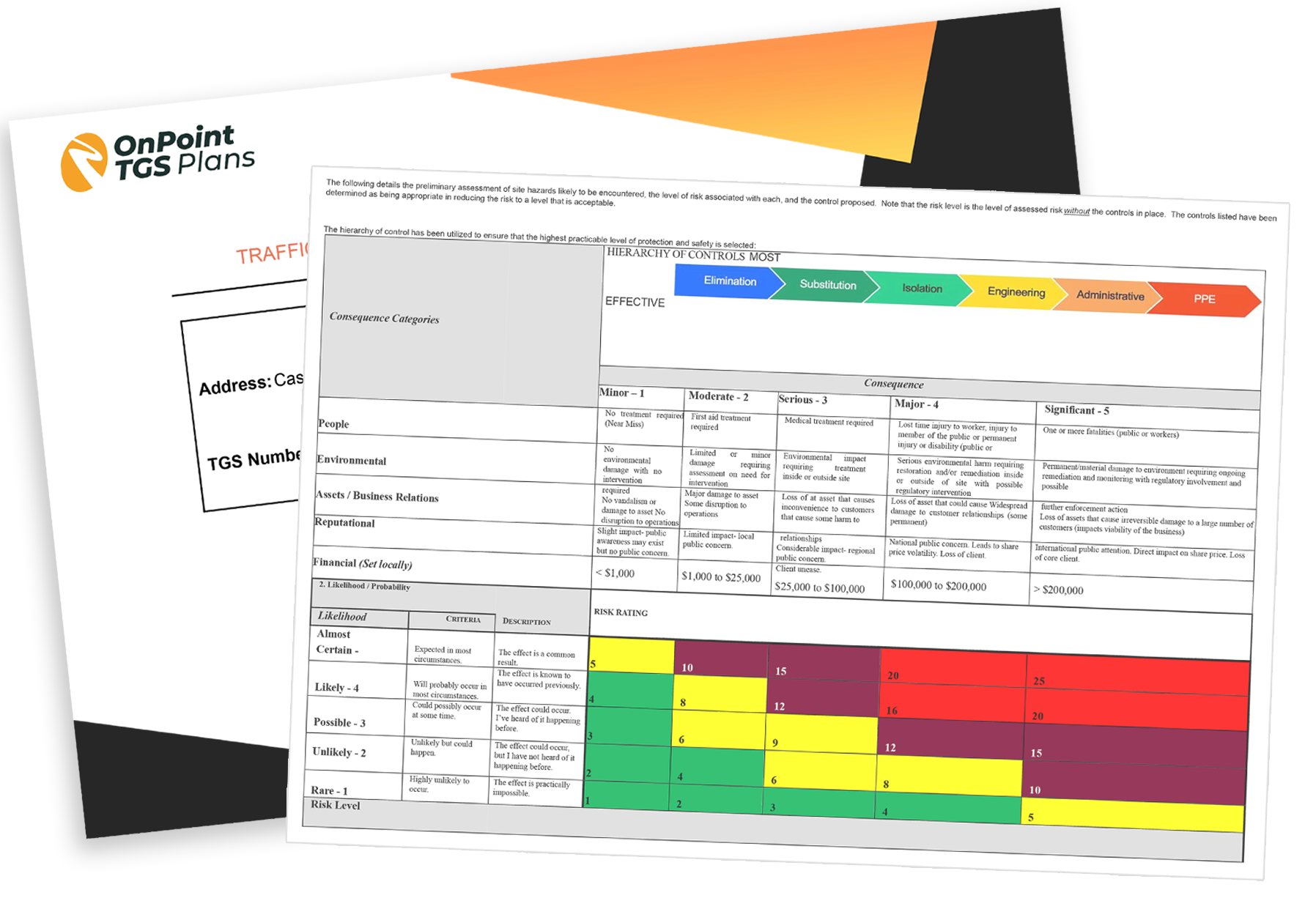
Risk assessment: identification of hazards including vehicle speed, pedestrian exposure, sight distance and emergency access
Traffic control strategy: the type of temporary traffic management to be applied, including any traffic controllers required
Traffic Guidance Scheme drawings: scaled layout diagrams showing device placement for each work configuration
Stakeholder and community notification plan: how affected residents, businesses and emergency services will be informed
Emergency management procedures: what happens if an incident occurs during works
Planner details and sign-off: name, qualifications and date of preparation

How to Get a TMP Approved by Council (Step by Step)
Getting a TMP approved in time to start work requires the right document from the start. Here is the typical process:
Confirm permit requirements: Contact the relevant road authority or council to confirm what documentation is required for your specific location and work type.
Engage a qualified planner: A TMP must be prepared by a person with the appropriate traffic management qualifications. Do not use generic templates for jobs with any complexity.
Provide site details: The planner needs the site location, work description, work hours, expected duration, speed zone and any site constraints.
Review the draft: Check that the TGS diagrams reflect your actual work area and that the risk assessment addresses site-specific conditions.
Submit with your permit application: Attach the TMP to your council or road authority works permit application. Some authorities require electronic submission through their online portal.
Allow for approval time: Most councils take 5 to 10 business days to approve a works permit. Submitting an incomplete or non-compliant TMP will reset the clock. OnPoint TGS documents are prepared to each authority's specific requirements to minimise re-submission delays.

State-Specific Notes for VIC, TAS, SA and NT
Victoria: Works on arterial roads managed by the Department of Transport and Planning require a TMP prepared to AGTTM Part 3 standards. Local road works are approved by the relevant council. High-risk activities require endorsement by a qualified Traffic Management Implementer (TMI) or designer.
Tasmania: The Department of State Growth requires a compliant TMP for all works on state roads. Council roads are managed by the relevant local authority. OnPoint TGS is familiar with Tasmanian approval requirements and prepares documents to the format preferred by state and local authorities.
South Australia: The Department for Infrastructure and Transport requires TMP submission through the Road Works and Events Coordination (RWEC) unit for state roads. Standard permit processing can take up to 10 business days.
Northern Territory: The Department of Infrastructure, Planning and Logistics administers TMP requirements for NT roads. Remote and high-speed road conditions often require additional buffer distances and risk controls within the TMP.
-
In most cases, yes. Any work in a road reserve that creates a hazard to traffic or pedestrians requires a permit from the relevant road authority or council, and that permit requires a TMP. This includes works such as service connections, landscaping, and telecommunications infrastructure. Check with your local council or road authority if you are unsure.
-
You can prepare your own TMP if you hold the relevant traffic management qualifications (typically RIIWHS302E or equivalent). However, for commercial projects, most road authorities require the TMP to be prepared and signed by a qualified traffic management planner. A poorly prepared TMP will be rejected, delaying your project start. Using an experienced planner is faster and more cost-effective in practice.
-
Most councils and road authorities take between 5 and 10 business days to assess a works permit application that includes a TMP. Urgent applications may be processed faster in some jurisdictions. Applications that are incomplete or include a non-compliant TMP will be returned and the clock resets. OnPoint TGS prepares documents to each authority's specific requirements to avoid re-submission delays.
-
A Traffic Management Plan (TMP) is the full management document that covers the project description, risk assessment, control strategy and stakeholder management. A Traffic Guidance Scheme (TGS) is the physical layout diagram that shows where traffic control devices are placed on site. A TGS is typically prepared as part of a TMP. For small, low-risk jobs, a TGS alone may be sufficient. For anything involving lane closures, council permits or construction works, a full TMP including a TGS is required.