
Services: Swept Path Analysis
Council compliant Swept Path Analysis across Australia
Swept Path Analysis for construction sites, developments and tight access areas. We simulate real vehicle movements so councils, engineers and builders know it works before construction begins.


Why clients use us


Same day Turnaround. No Project Delays.
Design change? Urgent submission? We deliver Swept Path Analysis the same day so your project keeps moving.
Avoid Costly Redesigns.
Clear, compliant modelling that helps councils approve faster and prevents expensive access mistakes.


Real Vehicle Simulation. Not Guesswork.
We model actual truck movements using industry-standard software so access works on site, not just on plans.
Complex Access? We Handle It.
Tight driveways, large rigid trucks, semi-trailers and cranes — we prove the manoeuvre works before construction begins.
What is included in a Swept Path Analysis
✅ Our plans are customised to your needs
A swept path assessment shows how a vehicle moves through a site and confirms that access is safe and practical.
Depending on your project, this may include
• Site entry and exit movements
• Vehicle turning paths and clearances
• Driveway and crossover design checks
• Basement and car park access
• Waste truck access for council approval
• Delivery and construction vehicle access
• Turning templates for specific vehicle types
We provide clear diagrams and supporting documentation suitable for council submission and planning approval.
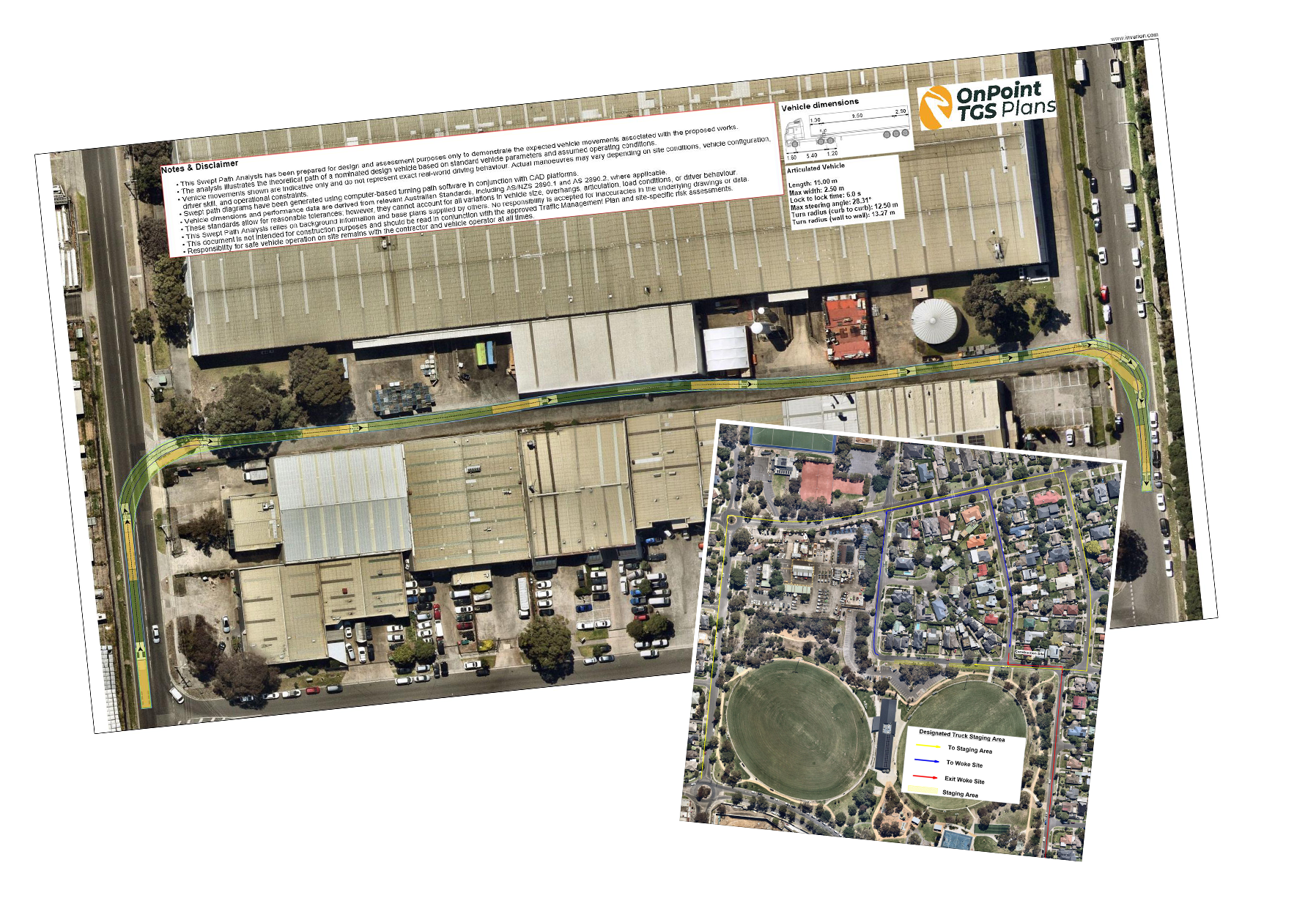

Get your swept path completed today.
Ready to start? Send your site details to OnPoint TGS Plans today for a prompt quote. We specialise in clear, compliant documentation delivered without the wait.
Clear, compliant and practical documentation without unnecessary delays.
When do you need a Swept Path Analysis in Melbourne?
Councils across Melbourne and Victoria commonly require a Swept Path Analysis as a condition of planning permits, building permits and development approvals. You will typically need one when:
A planning permit condition requires vehicle access to be demonstrated
A basement or car park requires council approval
A driveway or crossover is being constructed or modified
Waste truck or delivery vehicle access must be proven for a building permit
A construction vehicle needs to access a tight site
A large rigid truck or semi-trailer must navigate a loading dock or site entry
OnPoint TGS prepares swept path analyses for residential, commercial and industrial projects across Melbourne and Victoria. Our reports are formatted for council and planning tribunal submission.
A swept path analysis often goes hand in hand with a construction traffic management plan or a full traffic management plan for the same project. We can prepare the lot together.
Frequently asked questions
-
A swept path analysis shows how a specific vehicle moves through a site to confirm it can safely enter, exit and manoeuvre without hitting kerbs, buildings, parked cars or other obstacles.
-
You may need one for planning permits, building permits, council approvals, waste truck access, basement access, driveway design or construction vehicle access.
-
We can model a wide range of vehicles including waste trucks, delivery trucks, concrete trucks, fire trucks, semi trailers and site specific construction vehicles.
-
Typically within the same day once we have the drawings and vehicle details.
-
Usually architectural or civil drawings showing the site layout and access points. If you are unsure, send what you have and we will let you know.
-
Yes. We provide clear diagrams and documentation suitable for planning and permit submissions.